 Travel
Beyond the Water: How to Encounter the Bahamas as a Country
Junkanoo is a year-round discipline, not a Boxing Day parade — and Nassau is not the Bahamas. A better first trip crosses the hill and takes a Family Island seriously.
LuxTuris Editorial Desk · May 13, 2026
At Arawak Cay, conch salad is assembled to order with the speed and rhythm of practiced work. Its freshness should be established by asking the vendor rather than assumed; he cracks it from the shell, dices it live in front of you with a knife moving faster than seems advisable, then the onion, the tomato, the goat pepper, the sweet pepper, and finally the citrus — sour orange and lime squeezed over the whole thing in a bright flood. Behind him, somebody's speaker is playing rake and scrape, the saw rasping under the goombay drum, and residents and visitors share the tables, with the balance changing by hour, day and season. The cruise port is close in distance and far removed in cultural focus.
That distance is the subject of this piece. The Bahamas suffers, more than almost anywhere in the Caribbean, from being flattened into a postcard — water so famous it obscures the country attached to it. A first trip planned only around that water will be pleasant and will miss the Bahamas entirely. Here is how not to.
What Bahamian culture actually contains
Start with Junkanoo, because Junkanoo is the cultural heart and it beats year-round. The parades — Boxing Day and New Year's morning, when the groups rush down Bay Street in vast crepe-paper-and-cardboard costumes to a wall of goatskin drums, cowbells, whistles and brass — are among the hemisphere's great spectacles, with roots reaching back to the celebrations enslaved Africans built in their few days of Christmas liberty. But the parades are only the performance. The shacks — the workshops where the major groups (names like the Valley Boys and the Saxons carry the weight of football clubs) design and build their themes in secrecy for months — run all year, and understanding that Junkanoo is a year-round discipline of design, fundraising, rivalry and community is understanding the country's creative engine. Visit outside the season and Junkanoo is still there: in the museum downtown, in summer festival performances, in the shacks if you're invited.
Then rake and scrape, a distinctly Bahamian musical tradition: a carpenter's saw scraped with a screwdriver, a goatskin drum heated over fire to tune it, an accordion or guitar over top — music built, like steelpan, from what was at hand. It survives strongest in the Family Islands, especially Cat Island, which hosts the annual Rake and Scrape Festival, and in the older dance traditions that go with it.
And crucially, the geography of the culture: Nassau is not the Bahamas. The Bahamas spans hundreds of islands and cays, with population concentrated on a much smaller number, and the Family Islands — Eleuthera, Exuma, Andros, Cat Island, Long Island, Abaco — hold the settlements, fishing cultures, and unhurried rhythms that Nassau's density has traded away. A first trip that never leaves New Providence has read the cover of the book.
The route: Nassau done right, plus one Family Island
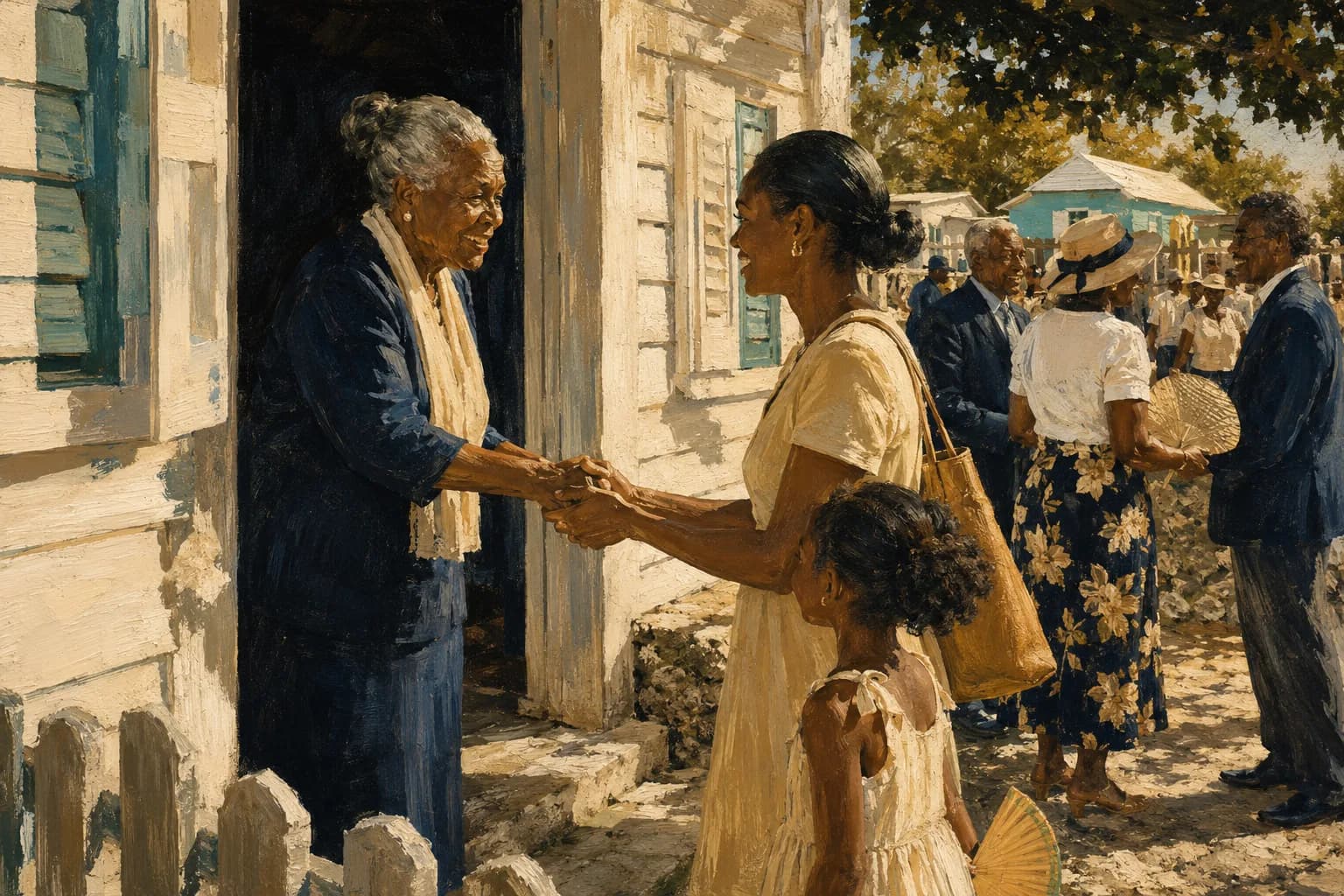
Nassau deserves two or three days, done respectfully — which means crossing the hill. Bay Street and the resorts sit on the waterfront; the historic heart of Black Nassau is Over-the-Hill, the neighborhoods south of downtown where the emancipated built their communities and where the junkanoo shacks, the old churches, and the city's memory live. Walk the straw market and the downtown historic sites, yes — but also eat at the Fish Fry with the locals rather than the cruise crowd (go when Bahamians go: late afternoon into evening, and Sunday), find a church service if you're the kind of traveler who accepts such invitations (Bahamian church music alone justifies the early morning), and take the museum time to understand Junkanoo and the country's road to majority rule and independence in 1973.
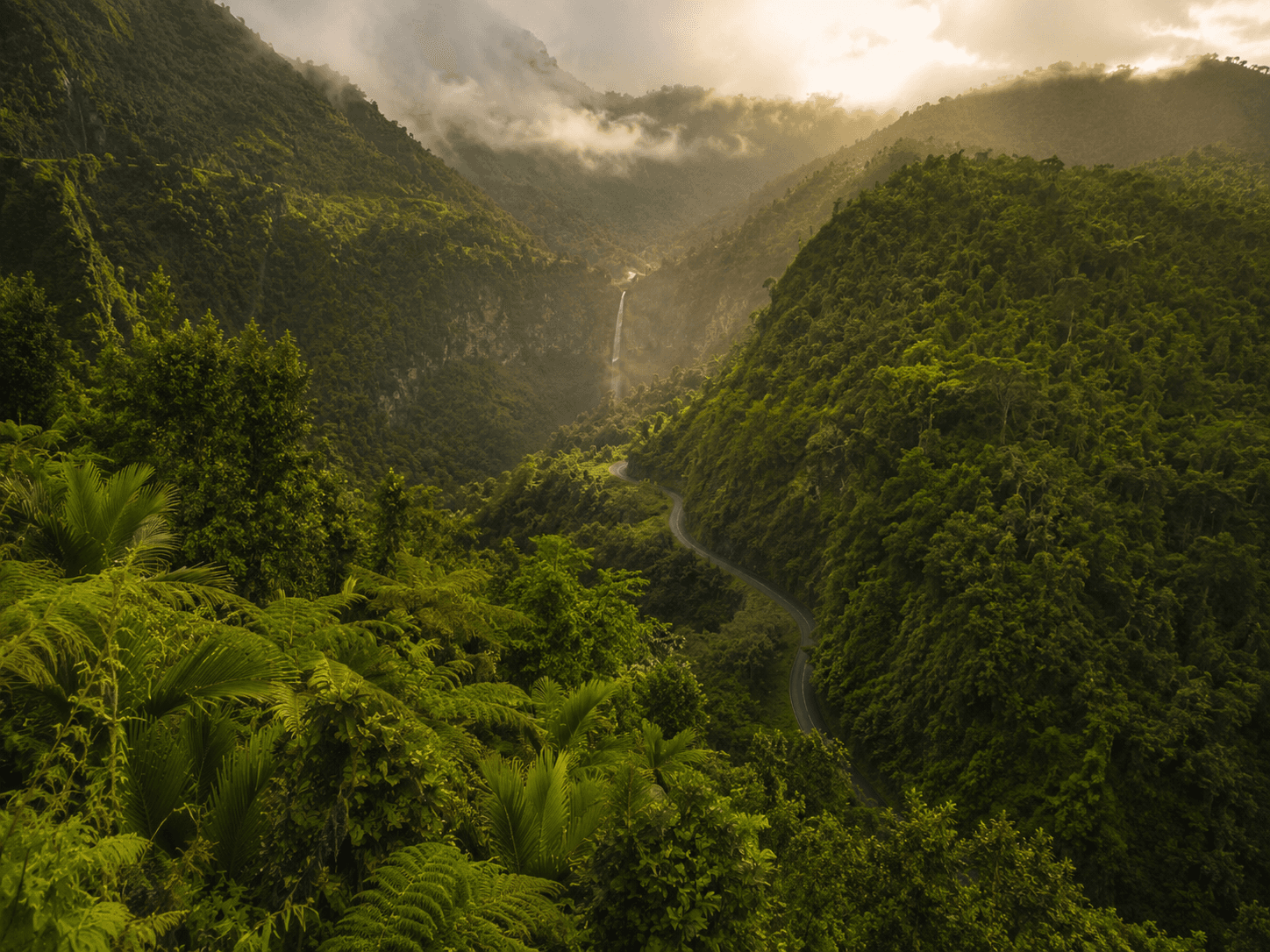
Then take one Family Island as the counterpoint — this is the move that transforms the trip. Eleuthera for pink sand, pineapple farms and settlements like Governor's Harbour where the evening entertainment is the harbor itself; Exuma for the water the postcards undersell and a string of small settlements down the chain; Cat Island for rake and scrape and the deepest quiet; Andros for bonefishing, blue holes, and the largest and least-visited landmass of them all. Pick one. Stay several nights, not one. Rent locally, eat at the settlement's two restaurants until they know your order, and let the pace reset you.
The food, named
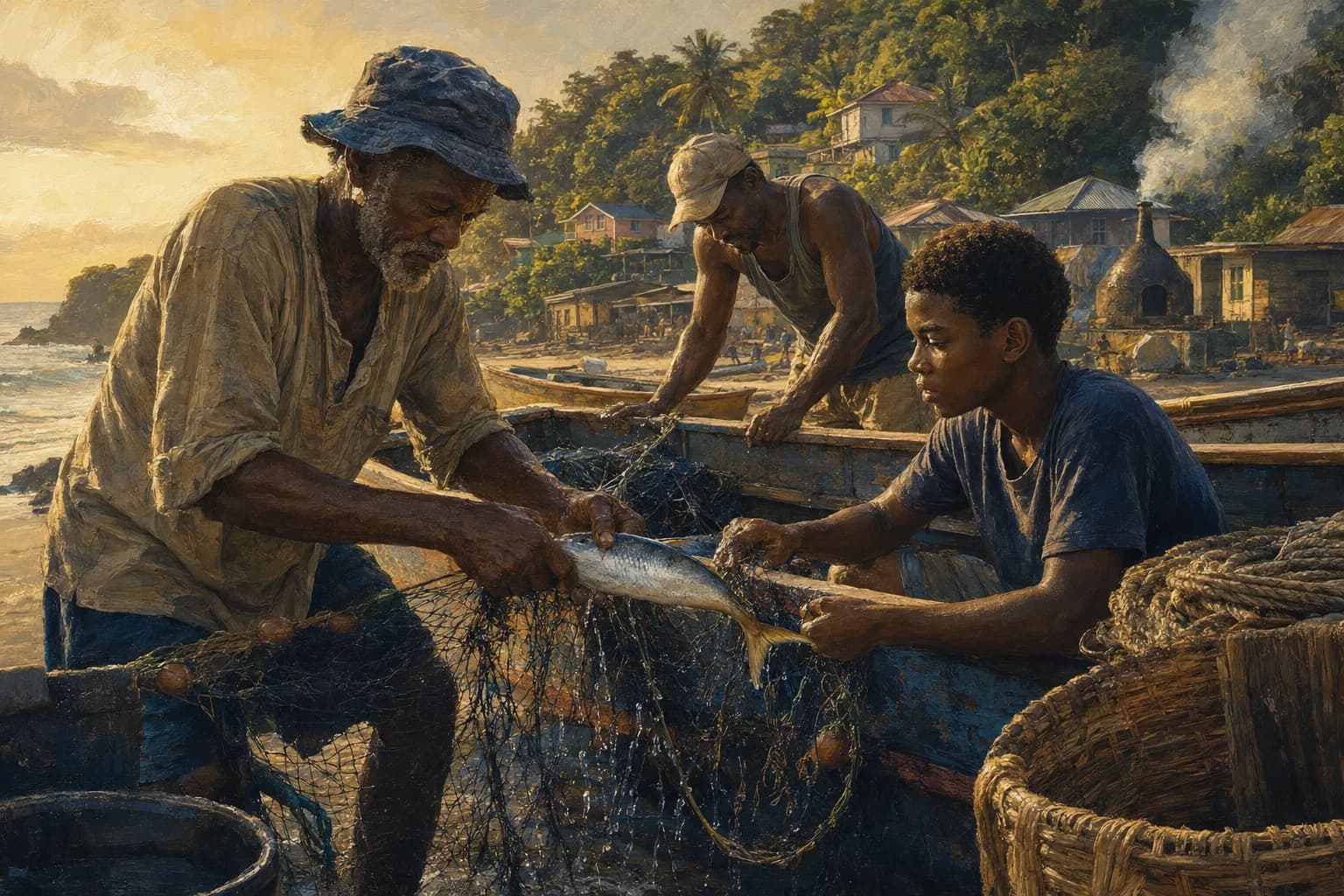
Beyond the conch salad liturgy already described: cracked conch (pounded, battered, fried) with peas and rice; conch fritters as the universal opener; boiled fish and johnnycake — the proper Bahamian breakfast, grouper in a buttery, lime-and-pepper broth with the dense bread alongside — best on a weekend morning; souse, the Bahamian version, light and citrusy, chicken or pork; and guava duff for dessert, the steamed guava-swirled dough with rum sauce that appears at every proper Bahamian table and vanishes just as quickly. On the Family Islands, add whatever came off the boat that morning, grilled behind somebody's house that is also a restaurant.
The practicals, in prose
Inter-island travel is the piece first-timers misjudge: the workhorses are small planes — Bahamasair and local carriers hop from Nassau to the Family Islands in under an hour, at fares that are a real line item but not a luxury one — while the mailboats, the freight-and-passenger vessels that have supplied the islands for generations, remain the slow, cheap, gloriously untouristed alternative for travelers with time and flexible spines. Ferries (Bahamas Ferries) cover some routes quickly. Season: winter is dry, bright and premium-priced; summer is hot, cheaper, and hurricane-aware — June through November wants travel insurance and attention. One honest cost signal: The Bahamas is not a budget destination — proximity to the US and a tourism-heavy economy keep prices high, and Family Island accommodation can be expensive, with rates varying sharply by island and season — so the budget lever is not cheapness but direction: spend less on resort polish, more on local hands.
Where to point your money
Which is the respect layer in one sentence: in a country of 700 islands, the overwhelming share of tourism money touches only New Providence, Paradise Island and a couple of cruise stops — so the most respectful thing a visitor's dollar can do is travel further than the visitor usually does. The Family Island guesthouse, the settlement restaurant, the local boat captain, the straw work bought from the woman who plaited it, the junkanoo museum ticket: this is the version of Bahamian tourism that lands where Bahamians live.
The postcard is real; the water genuinely is that color. But the country beyond it built Junkanoo from hard-won Christmas freedom, music from a carpenter's saw, and a cuisine around conch. To encounter more of it, cross the hill, ask permission, listen, and spend locally. Come for the water. Stay for the drum.
Editorial note
LuxTuris original
This is evergreen editorial context from the LuxTuris desk, not live breaking news or invented social proof.