 Heritage
Hosay: Mourning, Memory, and Belonging in Trinidad
A Shia Muslim mourning ritual carried by indentured labourers from 1845, joined by Hindus and Christians, and nearly erased by an 1884 massacre it still commemorates.
LuxTuris Editorial Desk · July 8, 2026
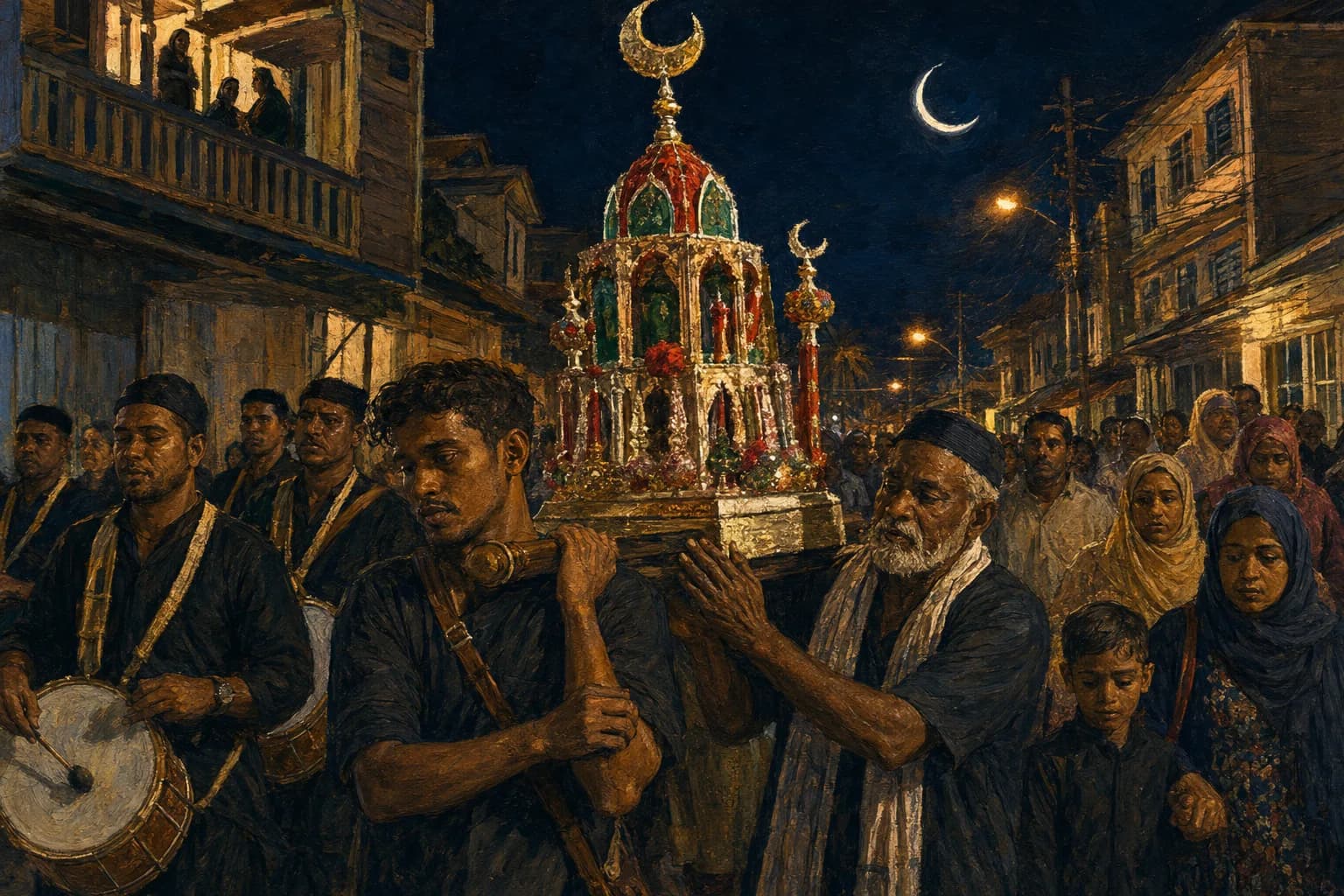
During Hosay in St. James, the Western Main Road becomes a place of mourning, procession and community witness. Men dressed in white strain beneath towering tadjahs, elaborate multi-tiered model tombs made from bamboo, bright paper, tinsel, and mirrors that catch every ray of light. Tassa drums thunder in tight rolls, the sticks moving so quickly that the rhythm blurs into a heartbeat.
Then the moons appear: two great crescents, one red for Husayn, cut down at Karbala, and one green for his brother Hassan, killed by poison. Each is heavy. Each is carried by a dancer who has trained for this, spinning and dipping the crescent through the crowd.
When the moons meet and touch—the kiss, people call it—a sound rises from the road that is neither quite a cheer nor quite a cry. Neighbours of every background line the route. Some sway. Some pray. Nobody simply watches.
This is Hosay, the climax of ten days spent building, fasting, and remembering.
Step inside those ten days.
It begins with Muharram, the first month of the Islamic lunar calendar. Families and yards—five of them in St. James, each with its own history, with Panchaiti the oldest and first in the order—gather in their camps.
For six days, the work is quiet. Artisans cut, glue, and layer bamboo frames with coloured paper and foil, building tombs that can rise fifteen feet or more. Each yard has its own closely guarded design. Drummers rehearse tassa patterns passed from mouth to ear. Devotees fast, pray, and retell the story of Imam Husayn ibn Ali, grandson of the Prophet, who was martyred at Karbala in 680 CE because he refused to bend to a tyrant.
Then the streets take over.
Flag Night comes on the seventh night, with poles in solemn colours moving through St. James past midnight. Small Hosay follows on the eighth, when miniature tadjahs are brought out, built for Husayn's infant son, who was also killed at Karbala. The moons make their first appearance.
Big Hosay comes on the ninth night, when the great tombs emerge in full glory beneath the streetlights.
On the tenth day, Ashura, the daytime procession begins. The tadjahs move in their fixed order, tassa rolling as the route retraces a path older than anyone walking it. The rites are timed to finish before sundown, as burial custom requires.
Afterwards, the tadjahs are carried to the water and committed to the sea, their bright forms returned to the waves. Hands blister from building. Shoulders ache from carrying. The air smells of sweat, incense, and salt.
All that work is dissolved on purpose. That is the point, not the price.
The roots are tightly braided, but the strands remain clear.
At its core, Hosay is a Shia Muslim observance, the mourning of Muharram carried across the ocean by indentured labourers who began arriving in 1845. Many came from Uttar Pradesh and Bihar, where taziya processions filled the streets of home.
The tassa came with them. The drums are Indian war drums, part of the same cargo of memory as the tombs.
What Trinidad added was everything around them.
After emancipation in 1838, Afro-Trinidadians living and working alongside Indian labourers joined the observance as drummers, builders, and mourners. Their participation helped turn a transplanted Indian rite into a Trinidadian one. Hindus joined. Later, Christians joined too.
In the early generations, stick-fighting displays known as gatka echoed the battle itself, though that element has largely disappeared from the modern road.
The colonial state contributed fear.
British authorities regarded the processions with suspicion, dismissing them as "Coolie Carnival" and imposing permits and route restrictions. In 1884, they went further and banned the processions outright.
On 30 October that year, thousands of marchers in San Fernando took to the streets anyway, refusing to allow the mourning to be legislated away. The police opened fire. Twenty-two people were killed.
The event is remembered as the Hosay Massacre, and it changed the meaning of the observance in Trinidad forever. Every tadjah that has moved along the road since carries not only the dead of Karbala, but also the dead of San Fernando.
When people describe Hosay as a commemoration of resistance, they are not speaking metaphorically.
For those within the tradition, Hosay carries a heavy responsibility.
It honours a stand against tyranny that indentured labourers recognised from their own lives under plantation rule. It provides continuity, preserving building skills and drum patterns passed down at a time when land and official documents were usually held by someone else.
Joy runs through the sorrow. The colours and communal meals after fasting insist on life in the middle of remembrance.
The observance also creates a solidarity the island still needs: Muslim, Hindu, Christian, Indo-Trinidadian, and Afro-Trinidadian, all sharing the same road.
One tadjah builder in St. James, wiping glue from his hands, explained the pull simply: the work reminds you who stood before you and what they carried so that you could stand here.
The pressures facing the tradition are real and should be named plainly.
Tourism boards are drawn to the spectacle and the photographs, often flattening a solemn observance into a "festival," a word the community itself resists. Migration drains the yards of working hands. Younger people leave for jobs abroad, and fewer builders remain.
Elders protect the fasting and the prayer, while some younger participants come only for the drums. Master builders die without apprentices, and their knowledge goes with them.
Still, Hosay continues because the need for it continues.
The observance travelled wherever indenture travelled. Jamaica's Westmoreland Parish maintained its own "Hussay" for generations. Guyana and Suriname developed tadjah traditions of their own, surviving bans and neglect to different degrees.
In the newer diaspora—the Indo-Caribbean neighbourhoods of Richmond Hill and Ozone Park in Queens, and the Trinidadian and Guyanese communities of London and Toronto—the observance often moves indoors, into community halls and backyards.
The prayers remain. The stories are retold. Smaller tadjahs are built in garages as deliberate acts of memory. Photographs are sent home to cousins who will stand on the Western Main Road that night.
Some families lose the thread. Distance and the shifting lunar calendar loosen the connection. Others hold it more tightly precisely because they are far away.
Every year ends in the same way.
The tadjah, carrying weeks of labour and a family's entire inheritance of skill, is walked into the water and released. The paper darkens. The tinsel loses its shine. The tiers separate, and the sea takes what the hands created.
Then the yards return home. When Muharram comes again, they build once more.
The whole tradition is contained in that single gesture: the form is surrendered so that the essence can return.
What Hosay asks of St. James, of Queens, and of anyone trying to keep something old alive is whether they are willing to rebuild when the old materials no longer fit.
Across generations, despite colonial repression, migration and social change, communities have continued to answer through the work of building, drumming, walking and remembering.
Editorial note
LuxTuris original
This is evergreen editorial context from the LuxTuris desk, not live breaking news or invented social proof.