 History
The Market at Dawn: Where Caribbean History Still Trades
Ground provisions, the higgler's ledger, the morning's prices — a Caribbean market at six a.m. is a history lesson that never announces itself.
LuxTuris Editorial Desk · May 9, 2026
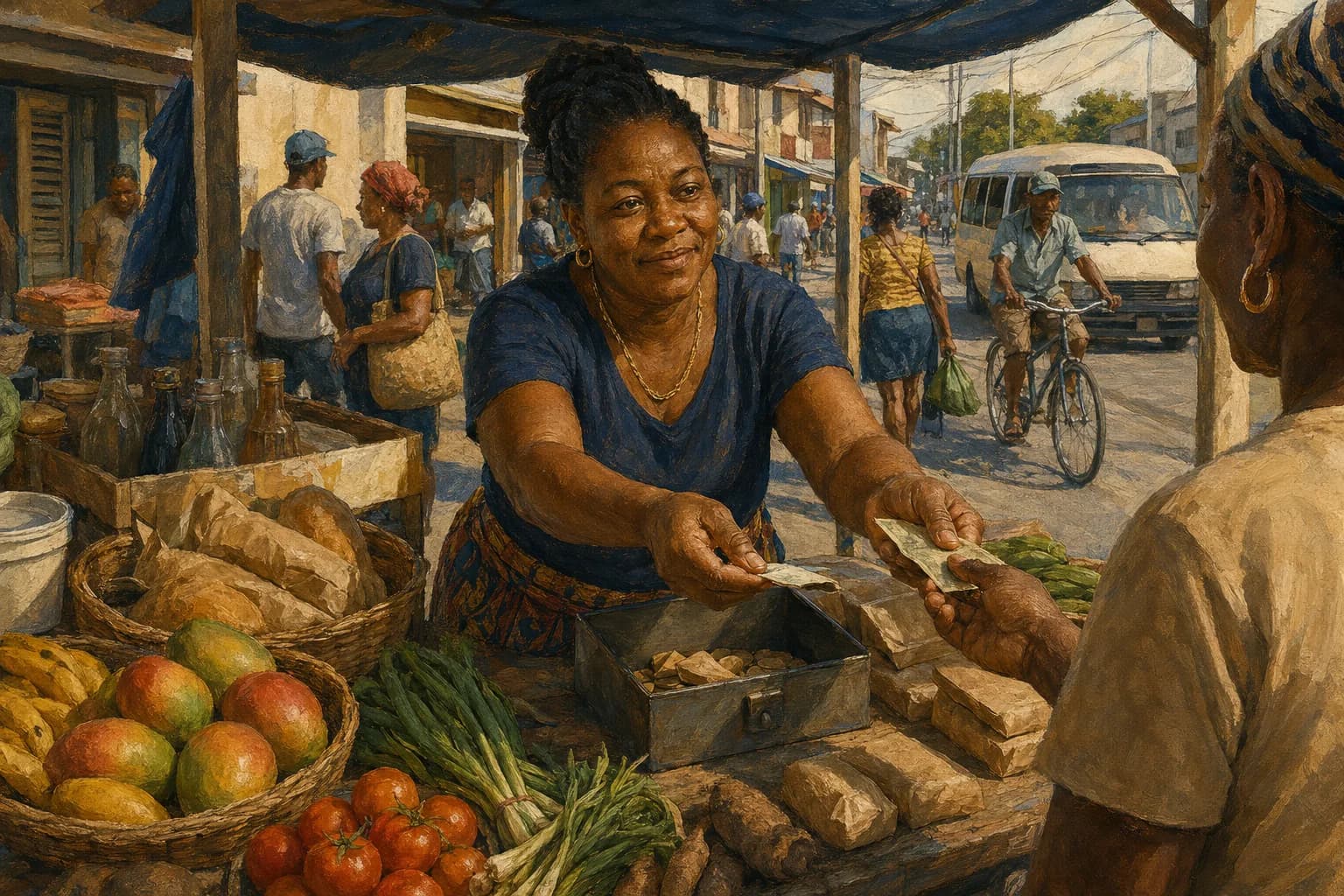
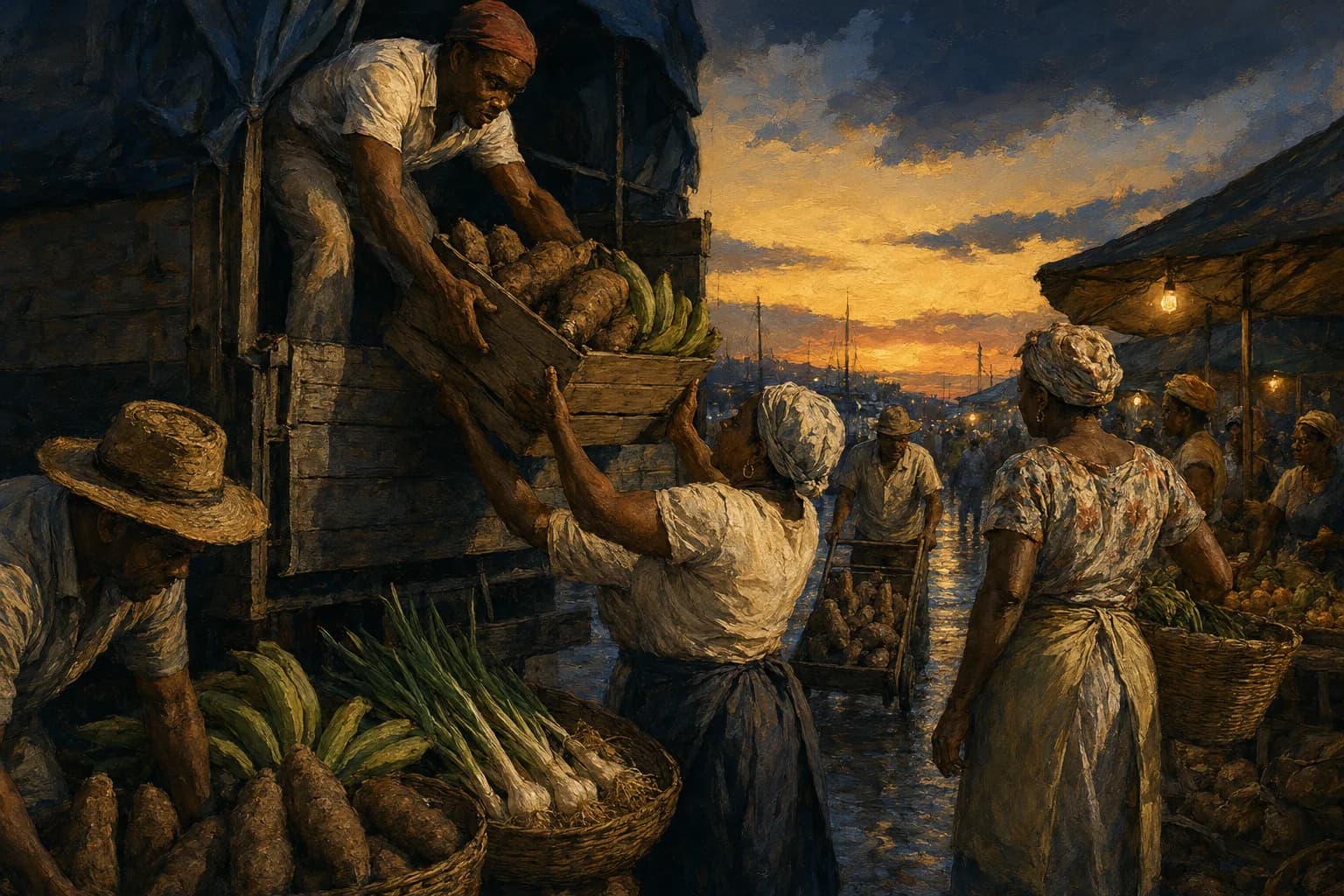
At six in the morning, a large Caribbean market is being assembled. Coronation Market in Kingston offers one powerful example, but each territory has its own institutions, routes and vocabulary. Trucks that left the hills in the dark are backed against the kerb, and the produce comes off in a relay of shoulders and shouted instructions: crocus bags of yam thudding down, hands of green banana, crates of scotch bonnet, tomatoes from one parish, cabbage from another. The vendors — many of them women, some continuing family businesses across generations — are building their stalls with the speed of people who have done it ten thousand times, calling prices and greetings and abuse at the truck men in equal measure. The first customers are already moving through: restaurant buyers, higglers stocking for resale, a grandmother who has bought her Saturday provisions from the same three women for thirty years. No bell rings. But make no mistake — school is in session.
Because a Caribbean market morning is a history lesson that never announces itself. Everything in it — the produce, the vendors, the routes, the prices, the very structure of who sells and how — is a text, and a visitor who slows down enough to read it will learn more about how the island came to be than most museums can teach. Here is the syllabus.
Reading the produce
Start with what is actually on the stalls, because the vegetables have a politics. Look at the ground provisions — the yams, the dasheen, the cassava, the sweet potato, the green bananas and plantain. These are not merely what grows here; they are what the enslaved made grow here. Under slavery, planters ceded marginal hillside land — the provision grounds — where enslaved people grew their own food in the scraps of time they were allowed, and it was there, on the worst land, that the real agricultural genius of the Caribbean developed: the African crops (yams that crossed the Atlantic in slave-ship holds), the Amerindian inheritance (cassava, its processing knowledge learned from the islands' first peoples), the salvaged and adapted everything-else. The plantation grew sugar for export. The provision ground grew the cuisine — and today's market stall is the provision ground's direct descendant, still selling substantially the same crops, still worked by substantially the same families. Meanwhile the imported goods on the margins — the US rice, the tinned things — tell the newer story: what the island no longer grows, what globalization made cheaper to ship than to plant. One stall, four centuries, legible to anyone who asks what's local.
The higgler: the backbone with a name
Now read the vendors, because the market's greatest historical text is the woman behind the stall, and she has a title: the higgler (Jamaica's word; other islands say hucksters, or market women, and mean the same institution). Her lineage is precise and remarkable. Under slavery, the one economic space enslaved people held was the Sunday market — the sanctioned day when provision-ground surplus could be sold, and enslaved women, walking miles with loaded baskets on their heads, became the traders. In those Sunday markets they accumulated the only money slavery permitted them, and with it bought cloth, goods, occasionally freedom itself. After emancipation, the higgler was the internal economy: the human supply chain moving food from mountain villages to towns, decade after decade, an infrastructure of women with baskets long before there were proper roads. Her modern descendants widened the routes — the "informal commercial importers" of the late twentieth century flying to Panama, Curaçao and Miami with empty suitcases and returning with goods, international trade conducted one airline baggage allowance at a time — but the job description never changed: buy where it's cheap, carry it yourself, sell where it's needed, trust your own ledger.
She is, in short, the founding entrepreneur of the Caribbean — historically female, chronically disrespected by officialdom, and utterly indispensable — and every market morning is her institution, still operating, still hers. When you watch the vendor extend credit to a regular on a promise, refuse it to another on a memory, and calculate spoilage, transport, family labor and cash flow entirely in her head before eight o'clock, you are watching centuries of accumulated commercial intelligence that no business school issued and no downturn has ever managed to repossess.
Reading the routes and the prices
Two more texts before the lesson ends. The routes: ask any vendor where her goods come from and you get the island's internal geography drawn for free — which parishes feed which towns, which market trucks left at 2 a.m., where the vendor herself travels from (often hours, often since before dawn) — the old rural-to-urban circulatory system, still pumping. The accents around you map it too: a big town market gathers the whole island's speech in one shed. The prices: the morning's numbers are an economics lecture in real time. The gap between local and imported tells you about trade policy and shipping costs; the week the onions doubled tells you about a drought or a customs delay; the haggling itself — ritualized, humorous, bounded by mutual knowledge of what things honestly cost — teaches the difference between negotiation as culture and beating down a woman's margin as sport. (Visitors: learn that difference. The market is a workplace; the two-dollar victory you're grinding for is somebody's school-fee money. Buy generously, ask before photographing anyone, and remember you're a guest in an institution older than the country's constitution.)
The market that emigrated
The tradition traveled the way everything traveled: with the people. In Brixton Market and Ridley Road in London, on Flatbush and Utica in Brooklyn, along Eglinton West in Toronto, the Caribbean market rebuilt itself in exile — the same yams and dasheen (imported now across an ocean to the descendants of the people who once carried them across a different one), the same call-and-response between vendor and regular, the same Saturday-morning liturgy performed under grayer skies. For the diaspora, the market abroad is a memory engine: first-generation shoppers navigate it on muscle memory, and second-generation kids trailing behind absorb, without knowing it, the same curriculum — what the food is called, what it costs, how their people talk when buying it. The classroom emigrated intact.
The archive that opens at dawn
So here is the landing, and the reading recommendation that goes with it. The Caribbean's official archives keep the planters' ledgers, the colonial dispatches, the records written by the powerful about everyone else. But the market is the counter-archive — the living record of what the supposedly powerless built: their crops, their trade, their women's wealth, their routes, their credit systems, their voice. It requires no appointment and charges no admission. It opens at dawn, six days a week, exactly as it has for three hundred years.
Go early. Buy your breakfast from a vendor who can tell you where the produce was grown. Ask her what's local and where it grew. Class is in session — and the tuition is a hand of bananas and the good sense to listen.
Editorial note
LuxTuris original
This is evergreen editorial context from the LuxTuris desk, not live breaking news or invented social proof.