 History
The History in the Shoebox: Caribbean Family Albums as Archives
A studio portrait from 1958, pencilled 'For Mama' on the back, is a document — and the Caribbean's great unofficial archive is dying faster than the official ones.
LuxTuris Editorial Desk · May 8, 2026
Take the photograph out of the drawer and actually look at it. Black and white, scalloped edges, a studio portrait: a young man, maybe twenty, standing rigidly beside a wooden chair he has no intention of sitting in, one hand resting on its back with the formality of a statesman. Behind him a painted canvas backdrop — vague columns, an implied garden. His suit is borrowed or brand new, the crease in the trousers sharp enough to date the pressing. He is not smiling; smiling was not what the occasion demanded. Turn it over: pencil, faded but legible — For Mama, 1958 — and the embossed stamp of a studio in a town your family hasn't lived in for two generations. In your hand is a document. A young man on the verge of something — a migration, a marriage, a first job in town — spent real money he did not have to be recorded looking dignified, and to send that dignity home.
Multiply that photograph by the drawer it came from, the shoebox above the wardrobe, the albums with the crackling plastic sleeves, the framed arrangement on the front-room wall — and you are looking at the Caribbean's great unofficial archive. Not every historical record sits in an institution. Some of the most complete ones are kept by families who never called themselves archivists, and this piece is about learning to read — and rescue — what they hold.
What the albums hold that institutions don't
Official archives preserve what officialdom noticed: registrations, court records, the newspaper's version. The family album preserves everything else, and its genres are worth naming.
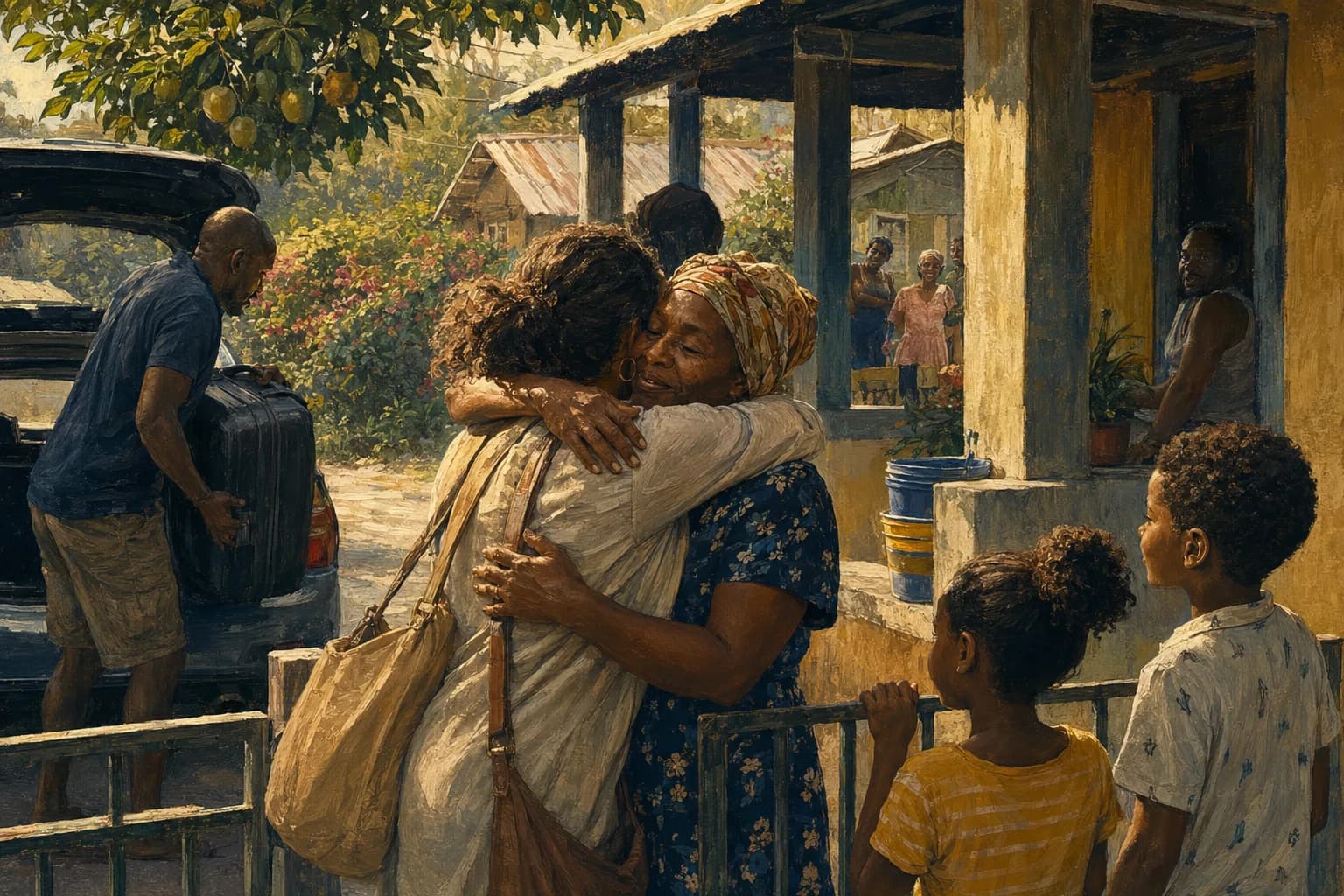
Migration, in snapshots. No archive documents the great Caribbean movements — to England, to America, to Canada, to Panama before them all — as intimately as the albums do. The airport photograph: the family clustered at the barrier around the one who is leaving, everyone in their best clothes, the suitcase in frame like an extra relative. The first-winter photograph, that great diaspora genre: the recently arrived, posed in snow in a heavy coat, grinning or grimly enduring, the print mailed home as proof of arrival and evidence of what the new life cost. The sent-home photograph: the studio portrait from London or Brooklyn — new suit, harder eyes — dispatched so the district could see that the child made good. Read in sequence, a single family's album traces a migration with a granularity Windrush scholarship would weep for.
The studio tradition. Before cameras were household objects, the photographer's studio was where the community went to be formally seen — christenings, confirmations, engagements, departures — and the town photographer was a village figure of real standing, part craftsman, part registrar. The stiffness of those portraits is not awkwardness; it is intent. People who spent their weeks in work clothes and other people's fields came to the studio to be recorded as they knew themselves to be: upright, serious, worthy of a backdrop with columns.
The group photographs as census. The wedding lineup on the church steps; the funeral gathering, everyone in white or black according to the island's custom — these are the community counting itself. Decades later they answer questions nothing else can: who was alive and present in which year, who stood next to whom (and who conspicuously didn't), which cousin had already gone to foreign and so appears nowhere. Add the school photos, the uniforms, the hairstyles, the church clothes, the yard visible in the background with its fruit trees and its fence — and the album quietly documents dress, prosperity, architecture and landscape across a century.
The wall. And then the front room's framed arrangement — the graduations, the wedding portraits, the son in foreign, occasionally a national hero or a Last Supper presiding — which is not decoration but curation: the family's official exhibition of itself, admission to which is earned. In many Caribbean homes, children understand without being told what it means to earn a place on the wall.
The fragile archive
Now the urgent part, because this archive is dying faster than the official ones. Its enemies are specific: hurricanes and floods, which have erased whole family collections in an afternoon — ask any family from a storm-struck island what was lost and photographs are named with the furniture; the tropics themselves — humidity, silverfish, the slow chemical fading that turns 1958 sepia into ghost; migration and moves, each one shedding a box; and above all, the deaths of the people who hold the captions. A photograph's information lives half on the paper and half in an elder's memory — that's your grandaunt Icilda, that was taken the year before she went to Panama, that house burn down long time — and when the elder goes, the photograph keeps its image and loses its meaning. An uncaptioned photo is a sentence in a language dying one speaker at a time.
The digital era cuts both ways, and honestly so. The WhatsApp forward is simultaneously the archive's best backup and its great scatterer: old photos get snapped with phones and broadcast through family groups — suddenly existing in forty copies across three continents, unlosable — but stripped of their backs, their pencil captions, their dates, compressed and cropped and orphaned from context. The record survives; the metadata hemorrhages. Saving the image without the story is embalming without the name.
The rescue, disguised as an afternoon
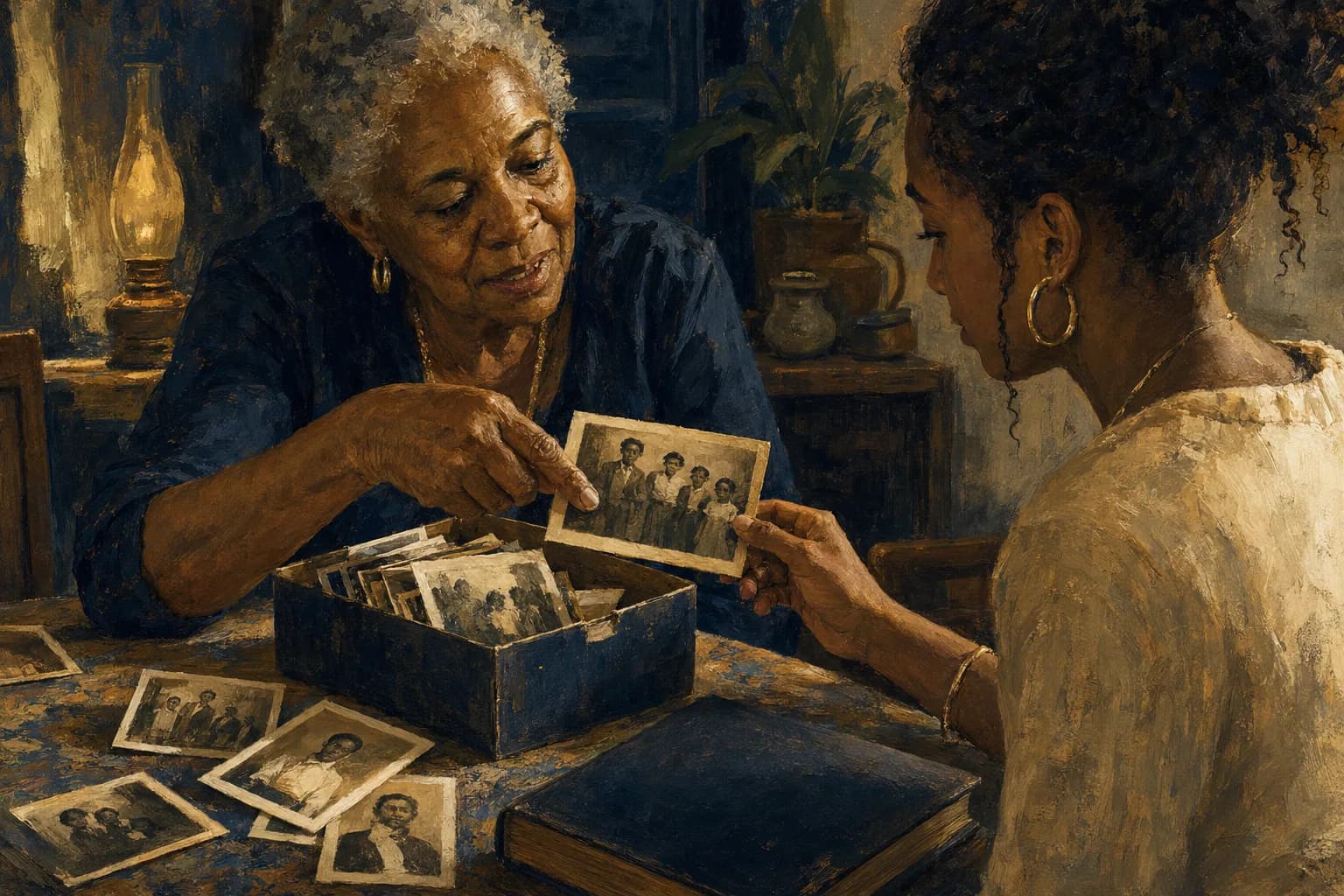
Which suggests the fix, and it is deliberately humble: not a preservation project — a visit. Take the shoebox to the eldest relative who can still read it. Go through it together, phone in hand: photograph each print (both sides — the backs are half the archive), and record the elder talking. Because here is the beautiful mechanism every family that tries this discovers: each photograph is an interview question that asks itself. The elder who answers "not much" to "tell me about the old days" will talk for twenty unprompted minutes when handed the picture of the church outing in 1963 — who's in it, who married whom, who vexed with whom, what happened after. The photos unlock the testimony; the testimony captions the photos; an afternoon produces an archive. The housekeeping that follows is modest: names, places and dates noted while known; copies in more than one place (a cloud folder shared across the family group does honorably); fragile originals out of the damp and the light; and — a courtesy the oral-record tradition would insist on — asking before private family images go anywhere public.
The history book the family wrote
Land back at the drawer. The Caribbean's story has too often been written by others, from outside, with the region as subject rather than author — which makes the family album something quietly radical: a history of the Caribbean written by its people, about themselves, in the medium of their own choosing, one dignified studio pose and one snowy arrival at a time. Nobody involved thought they were writing history. The young man by the wooden chair in 1958 thought he was sending his mother a picture. But that is exactly how the truest archives get made — accidentally, out of love, by people recording what mattered to them.
The book already exists. It is in the drawer, the shoebox, on the wall — unindexed, uncaptioned, and waiting. All it asks of this generation is an afternoon, an elder, and a phone. Go get the box. Ask who everyone is. Write it down while somebody still knows.
Editorial note
LuxTuris original
This is evergreen editorial context from the LuxTuris desk, not live breaking news or invented social proof.