 Language
More Than "Speaking Properly": The Intelligence of Register Switching
A twelve-year-old moves through four or five registers in a single Tuesday, flawlessly, without instruction — and school still calls it her problem.
LuxTuris Editorial Desk · May 11, 2026
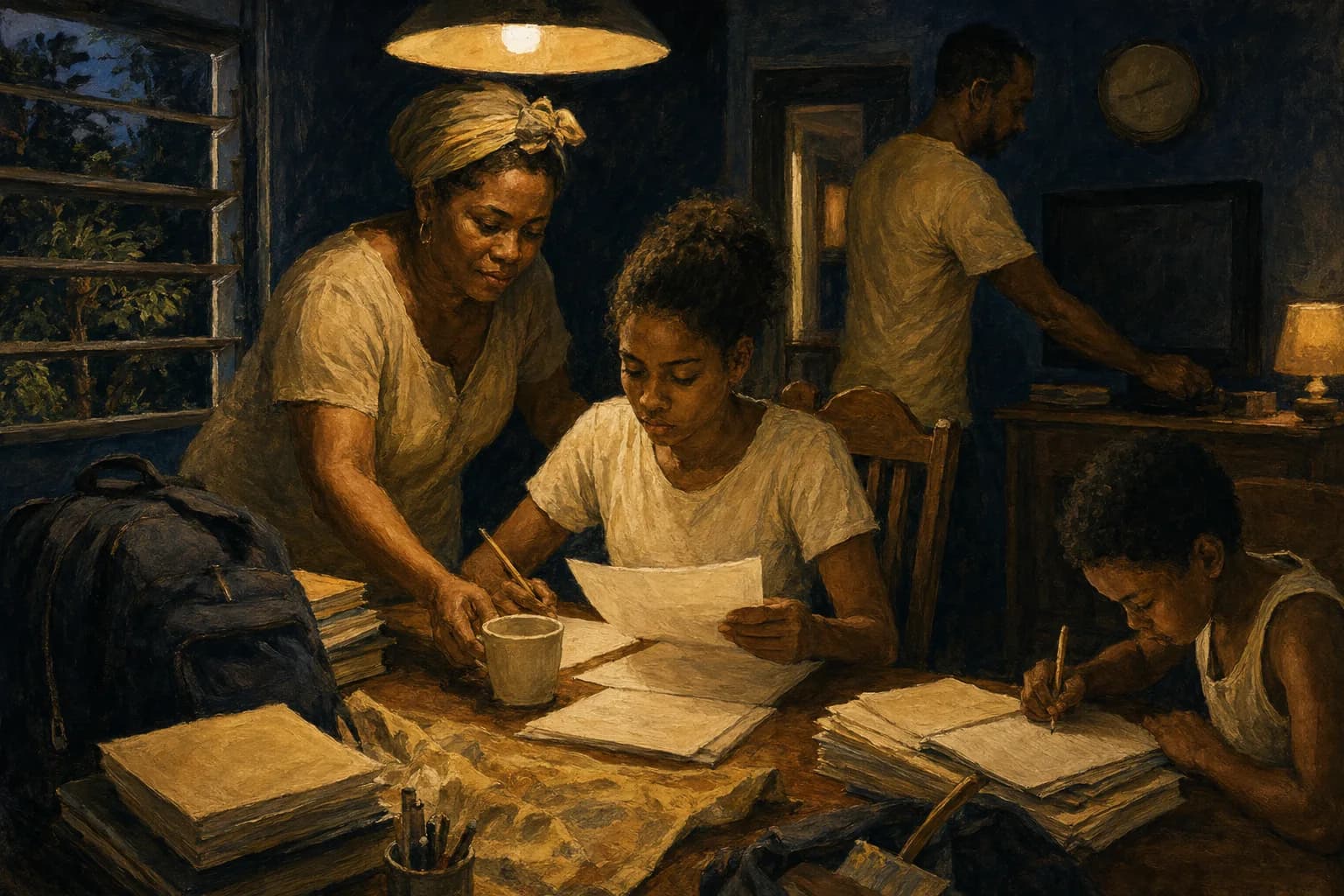
Follow one twelve-year-old through a single Tuesday. She wakes to her grandmother's voice and answers in the same tongue — the deep home register, all melody and dropped formality, the language of the yard. On the walk to school she talks to her friends in something adjacent but faster: the peer register, seasoned with this month's slang, performing casual mastery. The bell rings and she crosses an invisible border: hand up, "Good morning, Miss," and for the next seven hours her sentences wear uniforms too — classroom English, subject-verb agreements buttoned to the collar, because this room grades the grammar along with the answer. After school, the shop: a third voice, polite-but-local, the register for adults who know her family. Then her mother's phone is handed over — an aunt calling from foreign — and out comes a fourth voice, warmer than school, tidier than the yard, calibrated for a relative who left long enough ago to have opinions. By supper she has moved between four or five distinct registers, executing each border crossing instantly, flawlessly, and completely without instruction.
No one taught her this explicitly. No one graded it. And yet she is performing, dozens of times a day, a sophisticated act of linguistic and social judgment — a feat her school, if it is an old-fashioned one, may still describe as her problem.
The skill has a name
What the girl is doing, linguists call code-switching — moving between languages or language varieties according to context — and in the Caribbean's case the switching happens along what scholars describe as a creole continuum: a spectrum running from the deepest home creole to the most formal standard English, with speakers sliding along it moment by moment, selecting a point on the dial for each room, listener, and purpose. The families have their own vocabulary for it, of course, compressed into one loaded instruction: speak properly — a phrase every Caribbean child has heard, usually with a visitor or a teacher in range, and which translates as "shift registers, now, this room is formal."
Here is the reframe the whole piece turns on: a person who commands two grammars, two sound systems, two vocabularies, and — this is the hard part — an unwritten social rulebook for when each applies, is not a person with a language deficiency. Depending on the languages and varieties involved, they may command forms of bilingual or multidialectal fluency alongside a demanding social knowledge of when each register is expected. The achievement lies not only in knowing multiple systems, but in reading the room quickly enough to choose among them.
How the skill got called a problem
The history explains the insult. Colonial-era Caribbean schooling was built to produce standard English and treated the home language as the enemy of that production: children punished, mocked, or beaten for patois in the classroom, report cards lamenting the influence of "the dialect," generations taught that their mother tongue was not a language at all but a corruption — broken English, that durable slur, implying the child had somehow damaged a perfectly good language rather than natively speaking a different, complete one. The deep damage wasn't pedagogical but psychological: the lesson under the lesson was that the voice of your grandmother was a defect to be managed.
The scholarship has long since flipped the verdict. Linguists established decades ago that Caribbean creoles are rule-governed natural languages — Jamaican Patois has its own consistent grammar, tense system, and phonology, none of it random — which makes the creole-speaking child not a broken monolingual but a bilingual-in-progress. The modern educational argument, advanced by Caribbean linguists and championed publicly by scholars like Jamaica's Carolyn Cooper and the language researchers at the University of the West Indies, follows directly: recognize the home language, teach standard English as what it is — a second register with real utility — and stop teaching children to despise the first one. Bilingual education has never meant abandoning English. It means acquiring English without amputating anything.
The adult version, and its price
The Tuesday schoolgirl grows up, and the switching graduates with her. Now it is the interview voice — the register deployed across a desk from someone who will judge competence partly by accent. The customer service voice, maintained for eight-hour shifts. The professional diaspora calibration: the Kingston-born accountant in Toronto or the Lucian nurse in London running a workplace register all day, every day, with the home voice waiting in the car like a change of clothes. Done well, it is invisible — which is exactly the issue, because invisible labor goes unpaid and unthanked.
Honesty requires naming the cost. The performance takes energy — a low, constant hum of self-monitoring that monolingual colleagues never spend. It carries a psychic tax: the knowledge that the "professional" register is required because the home one is still, in too many rooms, quietly billed as unprofessional — meaning the switching skill exists partly as armor against a prejudice that should not exist. And it can carry grief: the parent who calibrated so thoroughly, for so long, that the home register never quite got passed to the children; the accent managed into extinction. The skill is real and admirable. The conditions that make it mandatory are worth resenting even as the fluency is worth celebrating.
The counter-movement
The good news is that the walls are moving. The patois-in-the-classroom debates — whether Jamaican schools should formally teach in and about Patois, whether creoles belong on the curriculum as languages of instruction — are live, serious, and increasingly mainstream across the region, unthinkable a generation ago. Literature settled its version of the question long since: from Miss Lou through the dub poets to the contemporary novelists who write dialogue in unapologetic creole and let the reader keep up, the region's writers have demonstrated that the home register can carry anything — comedy, scripture, grief, a Booker shortlist. Commerce followed: island advertising now sells in the vernacular because the vernacular sells, and the diaspora's digital culture runs a permanent open seminar in register play — the skit that switches voices for comic effect is a linguistics lecture, delivered by someone who never took the course. Each of these moves the line: the more rooms admit the home register, the less the switch is armor and the more it becomes what it always deserved to be — a stylistic choice in the hands of its owner.
Two grammars, one head
Land back on the girl at supper, five registers deep into an ordinary Tuesday, entirely unaware she has done anything at all. What she carries is not confusion but its opposite: fluency squared — two grammars and a live-updating map of exactly where each belongs, executed at the speed of conversation. The generations before her were taught to experience that inheritance as shame. The task of this one — of the classrooms, the parents, the publications like this — is simpler and overdue: tell her plainly what she actually is. Not a girl who can't speak properly. A girl who speaks severally — and switches between her languages the way a musician changes keys: mid-phrase, on purpose, without dropping a single beat.
Editorial note
LuxTuris original
This is evergreen editorial context from the LuxTuris desk, not live breaking news or invented social proof.